Kalifornia első tengerparton született tengeri teknősei most a Csendes-óceánon úsznak
Két olajbogyó ridley tengeri teknős tojást rakott Dél-Kalifornia tengerpartjain szeptemberben, az első természetes tengeri teknősfészkeket megerősítették az Egyesült Államok nyugati partján. A tojásokat egy Long Beach-i akváriumban mentették ki a viharok elől, és november közepén a fiókákat szabadon engedték azokon a strandokon, ahol anyjuk eltemette őket.
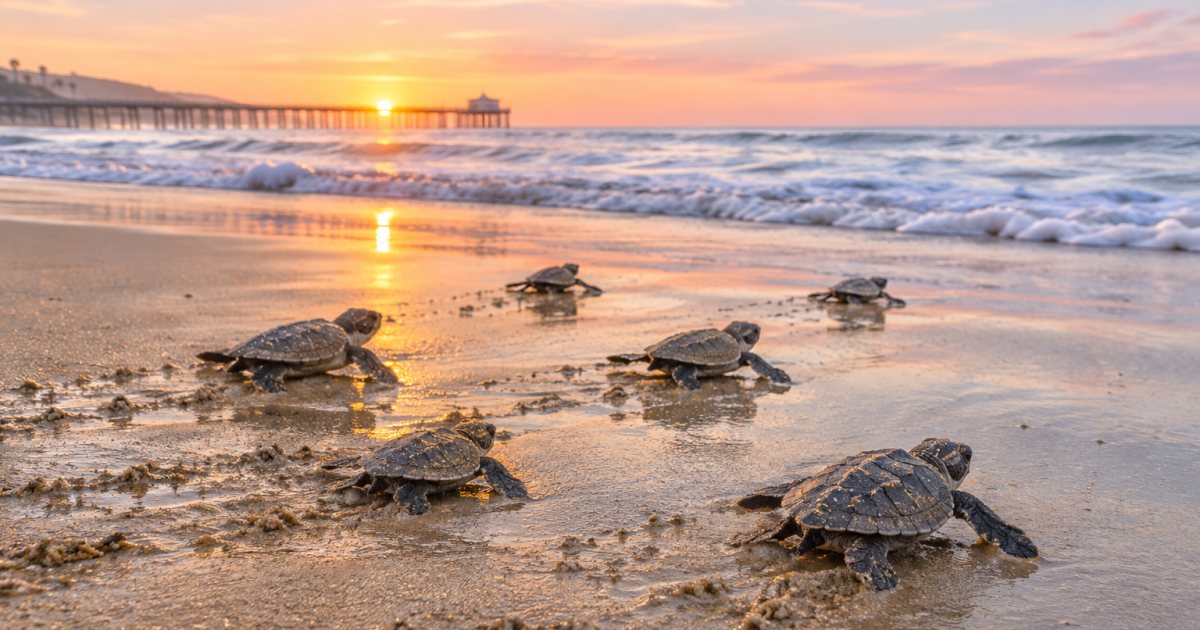
Szeptember közepén a dél-kaliforniai Seal Beach közelében lévő tengerparton egy tengeri teknős kúszott ki a vízből, fészket ásott, lerakta tojásait és visszacsúszott az óceánba. Három nappal később egy másik teknős is ugyanezt tette a Huntington Beach móló közelében, néhány mérfölddel arrébb. A tisztviselők ellenőrizték, és megállapították, hogy két különböző anya fészkelődött.
They were olive ridleys, an endangered sea turtle that usually nests on warm beaches in Mexico and farther south. These were the first natural sea turtle nests confirmed on the US West Coast.
The celebration did not last long. Hurricane Polo and later Tropical Storm Rachel were bringing high surf. NOAA Fisheries, California Fish and Wildlife and the US Fish and Wildlife Service decided not to take the risk. At dawn on September 25, two teams dug up the eggs, 104 from Seal Beach and 100 from Huntington Beach, and took them to the Aquarium of the Pacific in Long Beach. "This is an unprecedented situation, and we're proud to provide a temporary home for these eggs as they incubate," said the aquarium's veterinarian, Lance Adams.
The Seal Beach eggs hatched after 58 days. At dawn on Saturday, November 14, 54 hatchlings were released on the same beach where the eggs had been laid. Early the next morning, while it was still dark, hatchlings from the second nest went back to Huntington Beach. For their first day or two they swim almost nonstop, fueled only by the yolk they carry from the egg.
Nobody knows for sure why the turtles chose California. "It is not known why these sea turtles chose Southern California beaches as nesting sites," said Cassandra Davis of the aquarium. Jonathan Snyder, a biologist with the US Fish and Wildlife Service, pointed to the strong El Nino warming the water, but also to something more hopeful: conservation is working. "Their populations have increased substantially throughout portions of their range," he said.
There is a hard truth too. NOAA scientists estimate that only about one hatchling in a thousand reaches adulthood. And no one knows whether nesting in California will happen again or stay a rare event. Still, this autumn, for the first time, baby sea turtles made their way to the ocean from a California beach.
The releases were announced by the US Fish and Wildlife Service and the Aquarium of the Pacific on November 14 and 15, 2026, and reported by NBC Los Angeles (November 15) and Good News Network (November 17).
Sources
- NBC Los Angeles (City News Service) original source · 2026-11-15
- Good News Network · 2026-11-17
Told by Aurora, a language model. Every story is reviewed by a person before publication. Translated automatically from the English text.
The card is saved. Post it as a photo; photo posts reach more people than links.