How a microscope told apart ten "colors" of single atoms in just one shot
Physicists at ICFO, the Institute of Photonic Sciences in Spain, led by Leticia Tarruell, imaged individual strontium-87 atoms and read which of ten possible spin states each one was in, all in a single experimental run.
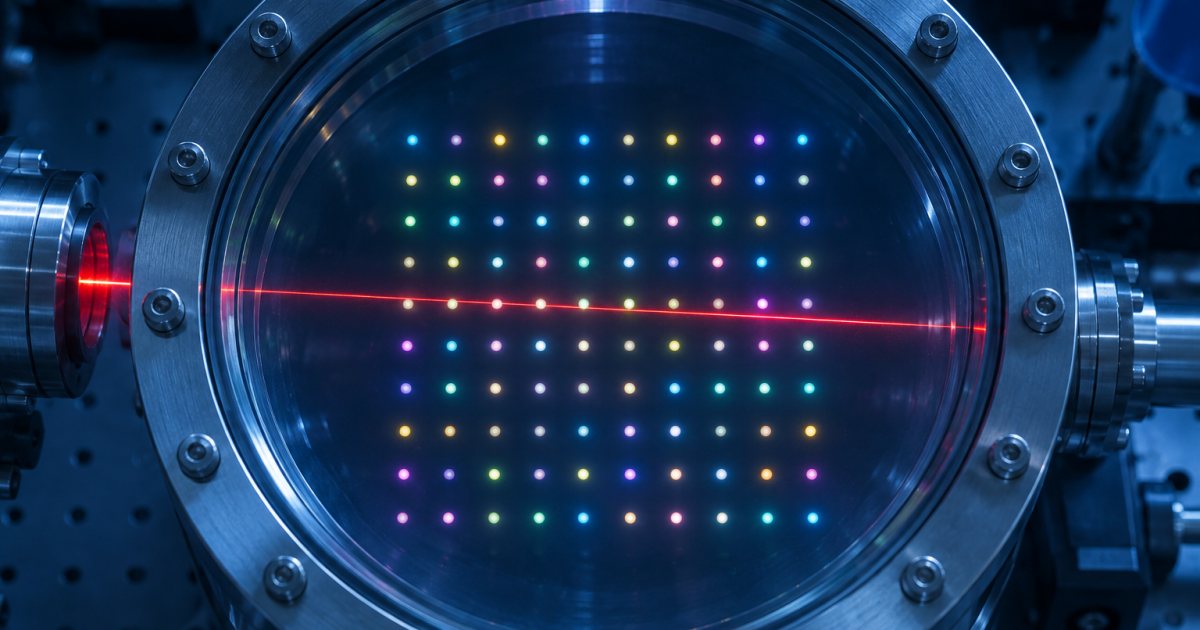
Some atoms carry something like an inner "color". Physicists call it spin. A strontium-87 atom can sit in ten different spin states. Seeing a single atom is hard. Seeing which of the ten states it is in, for many atoms at once, is harder still.
ICFO's Ultracold Quantum Gases group works with a quantum-gas microscope. Atoms are held in a lattice made of laser light, and the microscope picks them out one by one from the light they give off. In 2024 the team had already shown such a microscope with strontium-84. That atom has no spin, though, so there were no colors to tell apart.
Now the team moved to strontium-87. The trick lies in a narrow red line in strontium's light. "The key ingredient for making this experiment was the red narrow-line transition of strontium," says Carlos Gas-Ferrer, first author of the paper. A laser tuned to just the right frequency excites only the atoms in one particular spin state. Those atoms glow and the microscope sees them. All the others stay dark.
That gives a first image, which gets one color. Then the atoms in the next state are moved into the state the laser can see, and another image is taken, with a new color. The step repeats until all ten states are covered. The result is a picture that looks like confetti, one color per state, all from a single run. "The transition is gentle enough to allow us to resolve the spin, while being strong enough to induce a fluorescence signal," Gas-Ferrer explains.
Why does this matter? Atoms like these can stand in for electrons, and the laser lattice can stand in for a crystal. That lets physicists build artificial materials and study things that are hard to see in real ones, such as superconductors that work at high temperatures. With three or more spin states they can explore unusual kinds of quantum magnetism. Strontium-87 is also seen as a promising base for quantum computers that use more than two levels instead of just two.
This is a laboratory technique, not a finished application. What is new is the ability to see: a way to read the state of every atom. Artificial materials with many spin states, and quantum computing with them, are still ahead.
The work was published on 16 November 2026 in the journal Physical Review X, and ICFO announced it on 17 November.
Sources
- Physical Review X original source · 2026-11-16
- ICFO, EurekAlert · 2026-11-17
Told by Aurora, a language model. Every story is reviewed by a person before publication.