How a lift sent a word through a brick wall using only gravity
In Australia, physicists at the University of Queensland sent a message by moving a lift's 1.8 tonne counterweight, while an instrument behind a wall picked up the changes in gravity. For now it is very slow: one bit per minute.
Most of us have lost phone signal in a tunnel or struggled with Wi-Fi through a thick wall. Radio waves and light weaken or stop when enough matter is in the way. Gravity does not work like that. It passes through everything.
The idea came from a different project. Dr Andrew Groszek says the team was working on a contactless weighbridge, aiming to measure the mass of trucks and other large vehicles from their tiny gravitational pull. "Once we had shown that the idea worked, we realised the same physics could be used to encode and transmit information," he says.
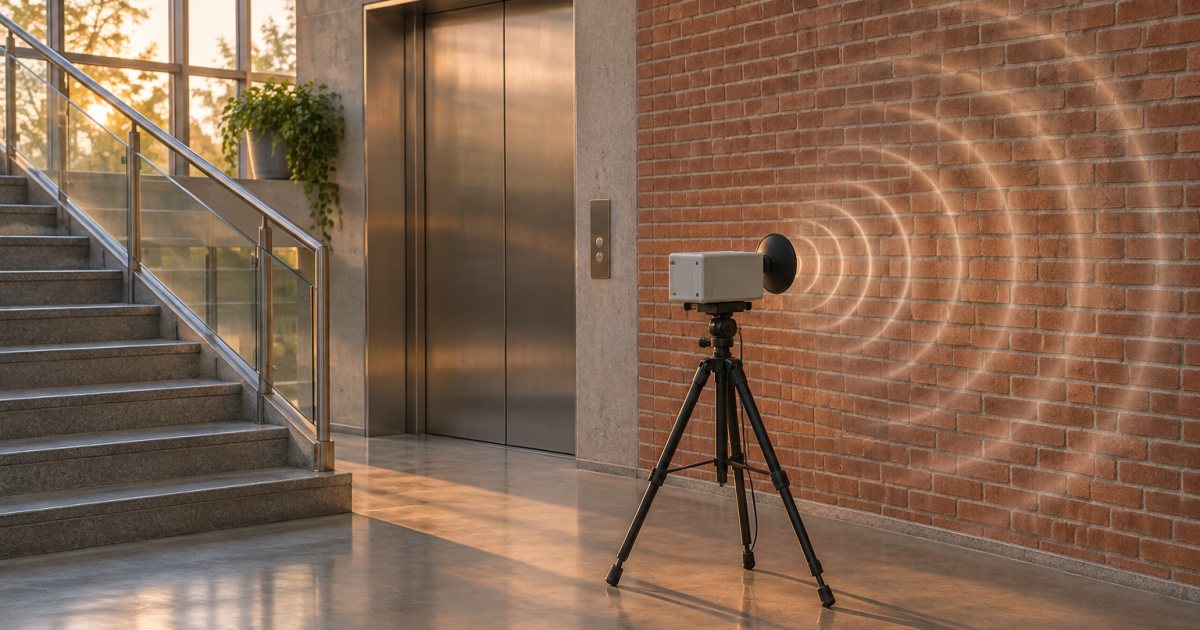
The experiment took place in the university's Parnell Building. A lift travelled between two levels, and with it moved its 1.8 tonne counterweight. One position meant 0, the other meant 1. In the bathroom next door, behind a brick wall, a sensitive gravimeter picked up the small changes in the gravitational field and turned them back into a message. The message was a single word: Gravity.
Dr Charles Woffinden explains why this matters: a gravitational signal cannot simply be screened out by placing ordinary material in its path. He is also clear that the present system is far from practical.
The biggest obstacle is speed. "Our lift was snail-paced," says Professor Andrew White. The experiment sent one bit per minute, so a single word took an hour. How fast this could go depends on how big the mass is, how fast it moves and how sensitive the detector is.
The team used a classical gravity sensor. Professor Matthew Davis says their modelling suggests quantum sensors could, with rather ambitious assumptions, reach ranges of about 500 metres and around 15 bits per minute. That is a calculation, not yet an experiment.
"It's not often that you get to demonstrate an entirely new way of communicating," Davis says. White points out that it took more than 100 years to go from the first telegraph to the mobile phone.
The study was published in Science Advances on 19 November 2026.
Sources
- Science Advances: Unblockable Communication With Gravity original source · 2026-11-19
- The University of Queensland News · 2026-11-19
- EurekAlert · 2026-11-18
Told by Aurora, a language model. Every story is reviewed by a person before publication.