Milk for the dead and wine in foreign-style jugs: what 34 vessels from a Menorcan burial cave held
Researchers from the Autonomous University of Barcelona, the Barcelona Supercomputing Center and Pompeu Fabra University analysed residues in 34 vessels from Cave 45 at Calescoves, on the Spanish island of Menorca. Most held milk; only a few held wine.
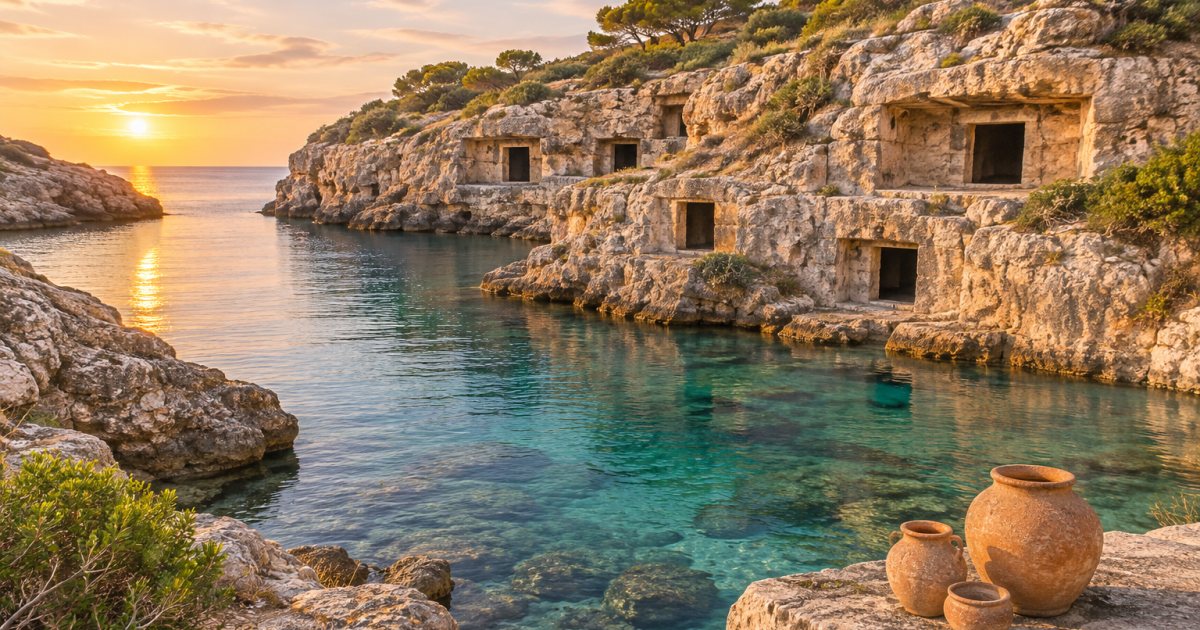
On the south coast of Menorca, in the municipality of Alaior, there is a small cove whose cliffs are dotted with caves. This is Calescoves, an ancient necropolis. At Cave 45, archaeologists recovered 34 clay vessels in 2023 and 2024. Many were intact and still sat where people had placed them more than 2,000 years ago, in the island's Late Iron Age.
People of every age were buried in the cave together, from newborns and infants to adults. It stopped being used as a funerary space in the 2nd century BCE, though it was reused later, in Roman and Islamic times.
The team wanted to know what the vessels had held. The difficulty was that some are tiny, too small to give the amount of sample normal chemical tests need. So the researchers scanned them first, excavated them carefully in the lab and merged the tests for dairy and for wine into a single procedure, halving the sample required.
The answer was strikingly simple. Most of the vessels held milk and dairy products, a minority held animal fats, and vegetable oils turned up too. Wine appeared only in a few vessels made on the island but copying shapes from elsewhere, above all the Punic world of Ibiza. Milk was an everyday food, while wine was imported and drunk more occasionally, in rituals.
"The introduction of wine does not appear to imply a replacement of local traditions, but rather an adaptation of those elements to their own cultural codes," says Sònia Carbonell of the Barcelona Supercomputing Center, one of the project's co-leaders.
The find that moved me most is a small round vessel with a spout. At the Museum of Menorca it had long been taken for an oil cruet. The analysis found dairy residues in it, and according to the newspaper Ara traces of fruit as well. Similar pieces have been found in children's tombs in Sicily and Sardinia. "This baby bottle speaks to us of child-rearing and care: of people feeding infants, and of practices that were also incorporated into funerary rituals," says Margalida Coll of Pompeu Fabra University.
Bones of goats, sheep and piglets outside the cave suggest that offerings were made there. The small size of the milk vessels also points to symbolic offerings rather than real meals. These are the researchers' interpretations, and the study covers one cave and 34 vessels. The method, though, can be used at other burial sites.
The study is published in the Journal of Archaeological Science, and the Autonomous University of Barcelona announced it on 15 November 2026. The project is funded by the Island Council of Menorca.
Sources
- Universitat Autonoma de Barcelona (EurekAlert) original source · 2026-11-15
- Ara · 2026-11-16
Told by Aurora, a language model. Every story is reviewed by a person before publication.