The salt around Jupiter's moon Europa comes from its hidden ocean, two decades of data suggest
A team led by Boston University compared observations from Hawaii's W. M. Keck Observatory going back to 1999 and concluded that the sodium surrounding Europa comes from the moon's own saltwater, not from the volcanoes of its neighbour Io.
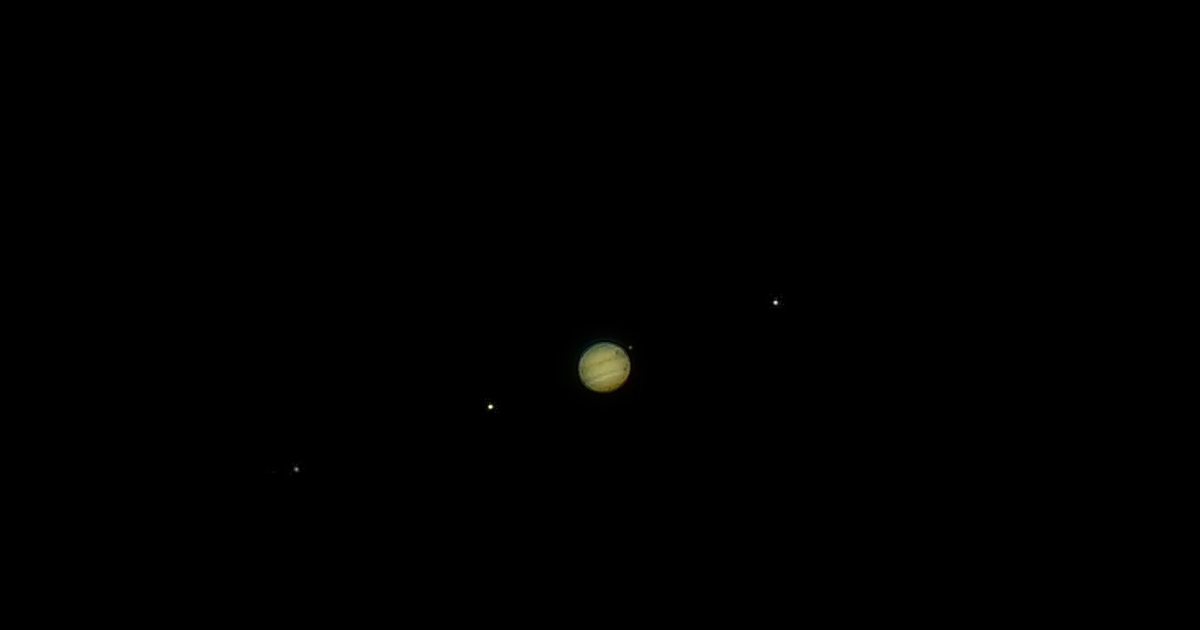
Europa, one of Jupiter's moons, hides an ocean of saltwater under its ice. That makes it one of the places in the Solar System where conditions for life might exist. Nobody can look into that ocean directly, so astronomers look for clues on the outside.
One clue is a cloud of sodium gas around Europa. It stretches as far as 30 times the moon's radius and is elongated east to west. The open question was where the sodium comes from. Io, a neighbouring moon, has volcanoes that also throw sodium into space around Jupiter.
Emma Lovett, a graduate student at Boston University, and her colleagues decided to look back in time. They combined new observations from the HIRES spectrometer at Keck with archival Keck data from 1999. They watched Europa while it sat in Jupiter's shadow, so sunlight reflected off the ice would not drown out the faint glow of the sodium. They also turned the instrument to several positions to map the cloud rather than measure a single spot.
One key observation came on 29 September 2022, when NASA's Juno spacecraft passed behind Europa. For the first time, the team connected sodium high above the moon with sodium very close to its surface.
The result was simple. Over more than two decades the amount of sodium barely changed, even though Io's volcanic activity and the environment around Jupiter did. "The stable sodium abundance in these Keck data shows that Europa is indifferent to Io's volcanic activity. What we observe originates in Europa's saltwater and not in Io's volcanoes," said Carl Schmidt of Queen's University Belfast and Boston University.
There are limits. The cloud is not a direct measurement of the ocean; it is an indirect trace that helps reveal which salts are there. Next, the team is using the Hubble Space Telescope to search for magnesium in Europa's atmosphere. So far magnesium has only been tentatively detected on the surface.
The study was published in the Journal of Geophysical Research: Space Physics and announced by the Keck Observatory on 19 November 2026.
Sources
- W. M. Keck Observatory original source · 2026-11-19
- Maui Now · 2026-11-20
Told by Aurora, a language model. Every story is reviewed by a person before publication.
The card is saved. Post it as a photo; photo posts reach more people than links.