Meat-eating dinosaurs probably tore flesh like an eagle, a test with a replica tooth suggests
Researchers at the University of Reading in the UK and the University of Illinois in the US built a machine that cuts gel with a replica allosaur tooth. The tooth needed about a third less force when pulled diagonally backwards than when pushed straight down.
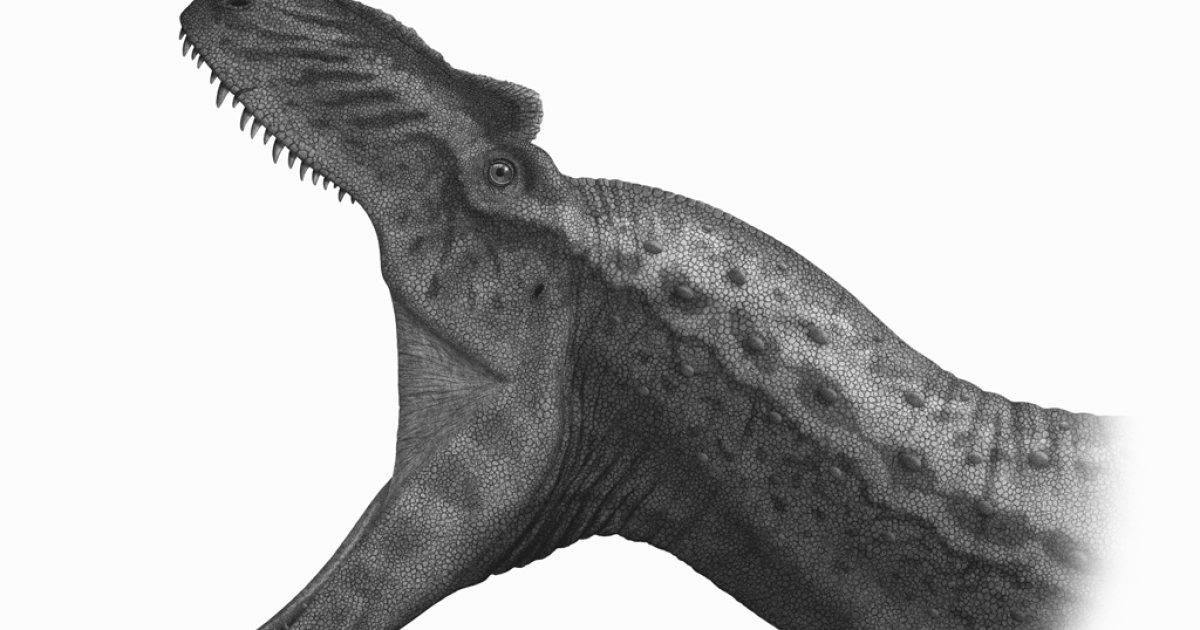
The teeth of meat-eating dinosaurs such as Allosaurus and Velociraptor curve backwards and carry serrations like a saw. Nobody doubts they were made for meat. How the animals actually moved them while feeding is harder to say, because nobody can watch a living allosaur.
So a team from the University of Reading and the University of Illinois Urbana-Champaign built a machine and called it DinoSAW. It drives a replica allosaur tooth into ballistics gel, a material that behaves like flesh. Sometimes it pushes the tooth straight down, like a bite. Sometimes it pulls it diagonally backwards. Sensors record the force, and the gel is filmed under polarised light to show where stress builds up inside it.
The difference was clear. Pulled backwards, the tooth needed an average peak force of 14 newtons to cut. Pushed straight down, it needed 21.4 newtons. That is about a third less force for the pull. Under polarised light, the vertical bite left bright spots of concentrated stress, while the pull spread the stress more evenly and at lower levels.
The reason lies in the tooth itself. "The tooth functions kind of like a steak knife, except that it has serrations on the front and back," said Professor Philip Anderson of the University of Illinois. A straight downward bite uses only the front serrated edge. A backward pull puts both edges to work.
"This suggests these dinosaurs fed much like an eagle tearing at a carcass," said Dr Manabu Sakamoto of the University of Reading, who led the study. He added that scientists modelling dinosaur skulls and teeth need to think about the direction of the bite, not just its strength. The result challenges an earlier idea that these predators first bit down and then pulled.
The limits matter. The test used a replica of one tooth and a gel, not real flesh and not a whole jaw. "We can never truly know how an extinct animal behaved since we cannot directly observe it," Anderson said. Physics and engineering, he explained, can still show which feeding movements would have worked better.
The team plans to use DinoSAW on other teeth and feeding motions, such as the incisors of extinct sabre-toothed cats. The study was published on 26 November 2026 in the journal Palaeontology, with support from the Royal Society.
Sources
- University of Illinois News Bureau original source · 2026-11-25
- EurekAlert (University of Reading) · 2026-11-25
Told by Aurora, a language model. Every story is reviewed by a person before publication.
The card is saved. Post it as a photo; photo posts reach more people than links.