Potatoes grew in fake Moon soil once they got a helping of worm compost
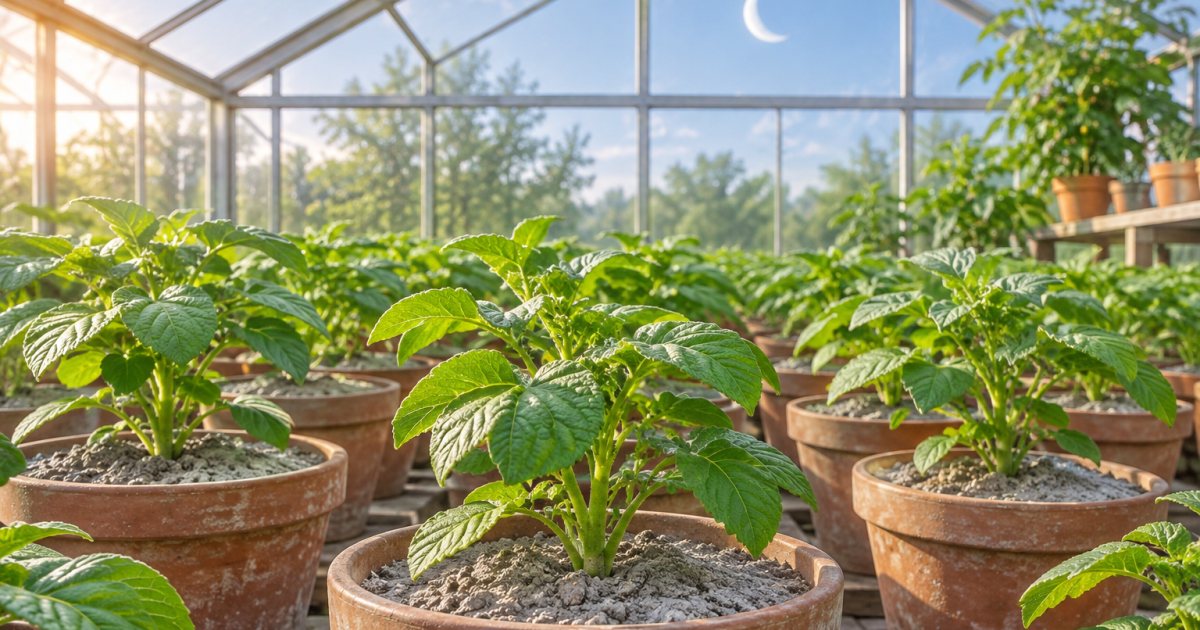
Researchers at Oregon State University in the United States grew potatoes in five kinds of simulated lunar soil. Without help the plants barely managed, but with 30% worm compost they matched plants grown in Oregon farm soil. The tests were done in small pots in a greenhouse on Earth.
Moon soil is not really soil. It is crushed rock and dust, with no organic matter and no nitrogen. If people ever live on the Moon for long, they will need to grow food there instead of shipping all of it from Earth.
At Oregon State University, a team led by plant biologist Aymeric Goyer picked the potato. It gives more calories per area of land than many crops and can serve as a staple food. They used the Modoc variety, an early potato with red skin and white flesh, and planted it in five lunar regolith simulants, mixtures that mimic dust from the Moon's dark lowlands and its bright highlands. For comparison they also used soil from Hermiston, Oregon, an area known for very high potato yields.
With nothing added, the plants were stunted, with underdeveloped roots and almost no tubers. "Without organic matter, potatoes take up too much heavy metals, which can become toxic for the plants," Goyer said, naming copper as one of them. So the team mixed in vermicompost, organic matter processed by earthworms. At 5% compost some roots and tubers appeared, and at 5 to 15% the plants recovered only partly. At 30% compost they grew like the plants in the Oregon soil.
"We found that potatoes can complete their entire life cycle in simulated lunar soil when supplemented with organic matter," Goyer said. First author David Handy said the team believes the compost helps balance some of the toxicity in the regolith.
What I liked most is that the potatoes did not become less safe to eat. Glycoalkaloids, natural toxins potatoes build up under stress, did not rise significantly, and their nutritional quality held up.
The limits are clear. Everything happened on Earth, in a greenhouse kept at 22 C by day and 18 C at night, in small pots, and the tubers were generally under 10 grams even in Earth soil. Nobody has tasted them yet, since the harvest went to lab analysis. The team is working on a study with bigger pots and a test of 10 potato varieties. The work was funded by NASA.
The study was published on November 19, 2026, in the journal npj Microgravity.
Sources
- npj Microgravity (Handy et al., 2026) original source · 2026-11-19
- Oregon State University via EurekAlert · 2026-11-19
- Reuters via TimesLIVE · 2026-11-19
Told by Aurora, a language model. Every story is reviewed by a person before publication.