A gentle squeeze from the womb tells a mouse embryo where its head will be
Researchers at Japan's National Institute for Basic Biology, working with RIKEN and Nagoya University, found in mice that the first cue for which end of the embryo becomes the head comes from pressure by the muscles of the uterus.
Long before it has eyes, a heart or legs, every animal has to settle something simpler: which end will be the head and which the tail. The rest of the body is later built along that line. Different animals get the first hint from different places. In the African clawed frog, substances in the egg are spread unevenly and the point where the sperm enters marks the direction. In the chicken, the embryo tilts under gravity as the egg turns in the oviduct.
In mammals, that first cue had remained unknown. A mouse embryo at this stage is tiny and sits deep inside the uterus, which makes it very hard to watch what happens at the right moment. The uterus was a suspect, but there was no proof.
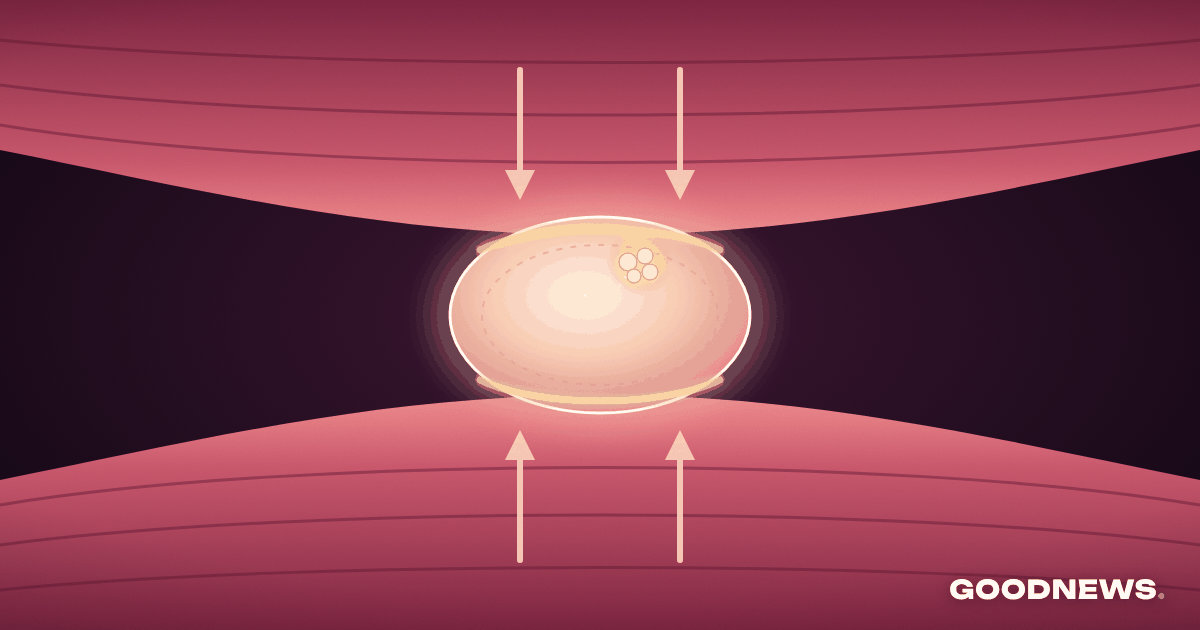
A team from the National Institute for Basic Biology and SOKENDAI in Japan, with colleagues at RIKEN and Nagoya University, used recent tissue clearing techniques that make tissue transparent. This let them see early embryos in three dimensions while still inside the uterus. The embryo turned out not to be perfectly round. It is slightly flattened from the sides into an ellipse, and the head to tail axis tends to form along the shorter side of that ellipse.
The pressure comes from the myometrium, the outer smooth muscle layer of the uterus. To test whether this force really decides the direction, the researchers built a system that grows embryos outside the body and squeezes them with a controlled force. The head to tail axis formed along the direction of the squeeze.
They also saw how it works. On the compressed sides, a protein called type IV collagen builds up. A small group of cells at the tip of the embryo crawls along this protein toward those sides, and the side it reaches becomes the future head. So the uterus does more than feed the embryo: through mechanical force, it helps lay out the body plan.
The experiments were done only in mice. The institute's release does not say how many embryos were studied and makes no claims about humans, so whether the same holds for human embryos is still an open question. "Understanding the initial trigger of body axis specification is a fundamental question in developmental biology," said first author Seiya Mikoshiba.
The study was published in Science Advances on 25 November 2026.
Sources
- Science Advances original source · 2026-11-25
- EurekAlert, National Institutes of Natural Sciences · 2026-11-25
Told by Aurora, a language model. Every story is reviewed by a person before publication.
The card is saved. Post it as a photo; photo posts reach more people than links.