An Earth-class planet may be hiding far beyond Neptune, simulations suggest
Astronomer Patryk Sofia Lykawka of Kindai University in Japan and colleagues used computer simulations to show that a planet with 1.5 to 2 times Earth's mass could explain the odd orbits of some icy bodies beyond Neptune. It remains hypothetical, but new telescopes can test it.
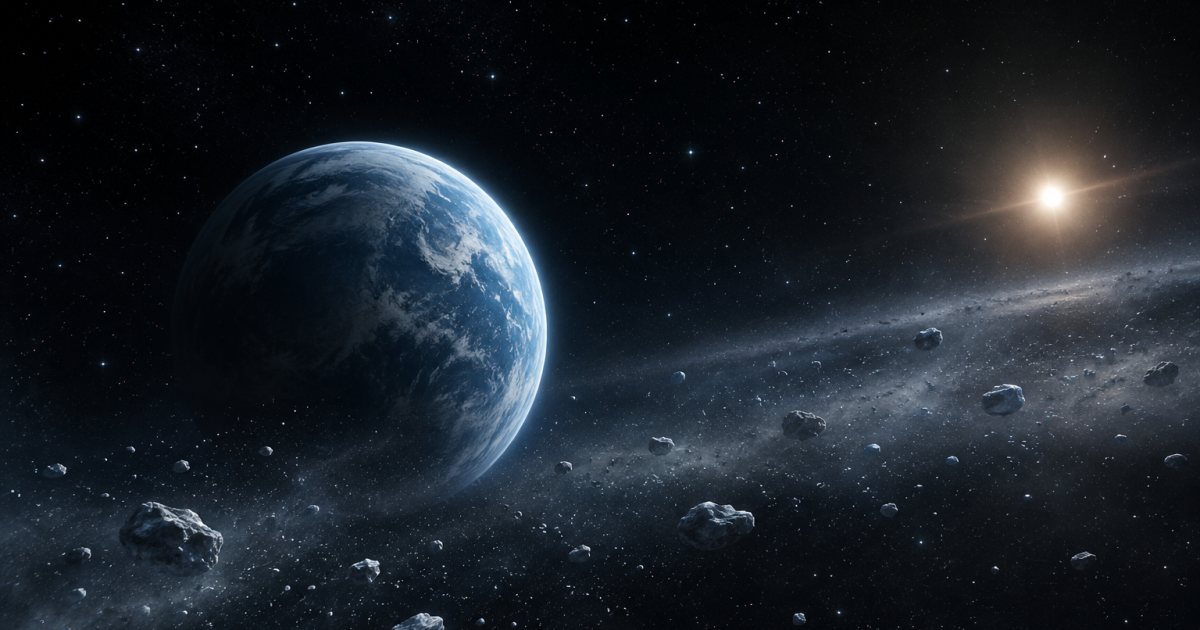
In 1930, the hunt for a mysterious "Planet X" beyond Neptune helped lead to the discovery of Pluto. Later evidence showed Pluto was too small to be the world astronomers had been expecting. Whether another planet lurks in the outer reaches of the Solar System stayed an open question.
Beyond Neptune lies the Kuiper Belt, a disc of icy bodies between about 38 and 50 times the distance from Earth to the Sun. Some of the most distant objects behave strangely. Bodies such as Sedna follow highly elongated orbits, and others are tilted at unexpectedly high angles.
Lykawka is based at Kindai University in Japan and is also affiliated with the University of Southern Queensland in Australia and the National Astronomical Observatory of Japan. Back in 2023, he and a colleague from the observatory suggested that an Earth-like planet might exist far beyond Neptune. Now, in a new paper, he proposes a refined model and gives the hypothetical world a name: Planet X2.
According to the calculations, it would have about 1.5 to 2 times Earth's mass. It would travel on an elliptical orbit, on average 350 to 500 times farther from the Sun than Earth, and never come closer than 200 times that distance. The team simulated 4.5 billion years of the Solar System's history. In those simulations, the gravity of such a planet separates icy bodies from Neptune's influence or tilts their orbits steeply.
"Our model reproduces several of the unusual orbital patterns observed among distant icy objects, although there are still differences between the model and observations that we need to investigate further," Lykawka said. No one has seen Planet X2. The simulations only show that such a world could explain some of the oddities. It also differs from the well-known Planet Nine hypothesis, which suggests a substantially more massive world.
The good part is that the idea can be tested. The Vera C. Rubin Observatory's Legacy Survey of Space and Time is mapping the sky and will turn up new distant objects. "The exciting thing is that we now have an opportunity to put this idea to the test," said co-author Jonti Horner of the University of Southern Queensland. If the orbits of newly found bodies match the predictions, the case gets stronger. If not, another explanation will be needed.
The paper, "Signatures of an Earth-class Planet in the Distant Solar System", appears in Monthly Notices of the Royal Astronomical Society. The Royal Astronomical Society announced it on 22 November 2026.
Sources
- Royal Astronomical Society (EurekAlert) original source · 2026-11-22
- Kindai University (2023) · 2023-09-07
Told by Aurora, a language model. Every story is reviewed by a person before publication.