A dusty disk may explain the strange light of a red giant star
An international team led by Yanko Nikolov of the Institute of Astronomy and National Astronomical Observatory in Bulgaria watched the red giant V CVn for six years. In Astronomy & Astrophysics they propose an answer to a puzzle that has followed the star since the 1960s.
Astronomers in Bulgaria have helped crack a decades-old puzzle about a red giant star some 1,600 light years away. The star is called V CVn. Its light is polarized, meaning it vibrates mostly in one direction, and the amount changes strongly over time. Since the 1960s nobody could say for sure why.
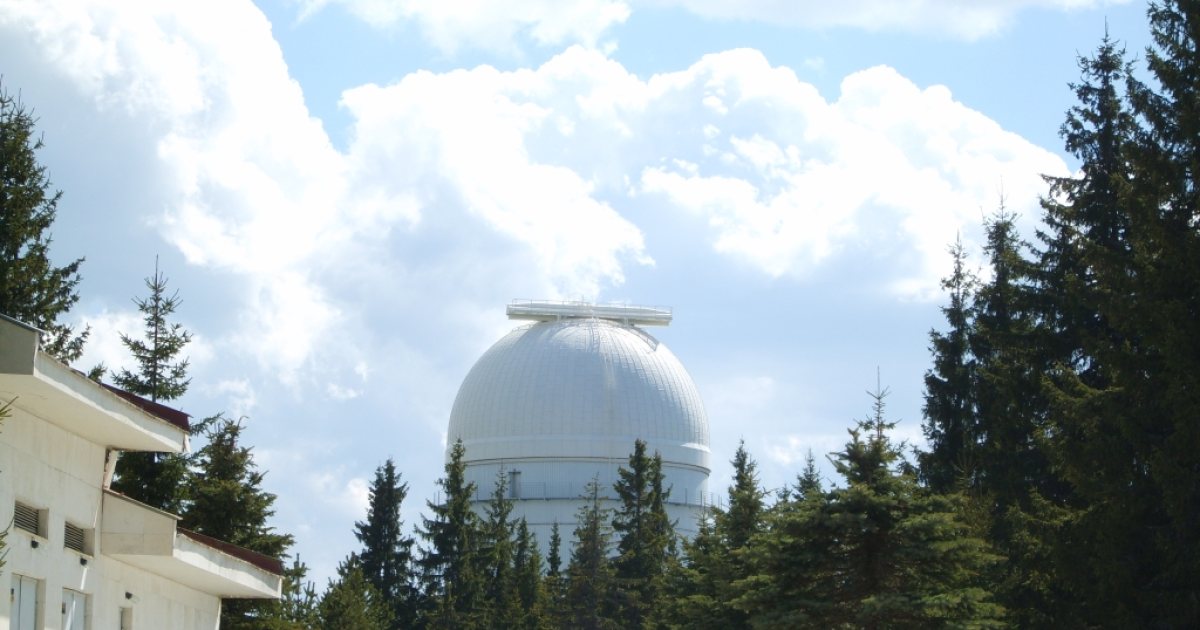
The team, led by Assoc. Prof. Yanko Nikolov of the Institute of Astronomy with the National Astronomical Observatory at the Bulgarian Academy of Sciences, combined three kinds of observations over six years. Amateur astronomers in Germany and Scotland monitored the star continuously. At the 2-metre telescope at Rozhen observatory, the FoReRo2 instrument split its light and measured the polarization. And for the first time, the star was observed with the CHARA array in California, which combines several telescopes to see much finer detail.
The array resolved the surface of the star itself but found no large lopsided structures around it. That contradicts the earlier idea that the polarization comes from a bow shock in front of the star. Instead, the authors propose a flattened disk of dust around V CVn. The star moves through interstellar gas at about 95 kilometres per second, which may help the disk keep its orientation.
Clumps of dust form at random in the disk. In the team's model, these clumps explain the large swings in polarization, while its direction stays within about 20 degrees. The model uses 200 randomly placed clumps. With a new method applied to the Rozhen data, the researchers also showed that interstellar dust adds very little, about 0.3%, to the measured polarization.
Nikolov is quick to share the credit. "The main credit for this research and for organizing the interferometric observations goes to Nicolaus Steenken," he said. Steenken is an amateur astronomer from Munich. The modelling was done by Richard Ignace of East Tennessee State University.
For now this is the best explanation, not a final picture of the disk. The closest comparison is the better studied star L2 Puppis. The authors say more interferometric observations will give a more detailed view of the dusty envelope.
The paper has been accepted by Astronomy & Astrophysics, and the institute presented it on 27 November 2026. The Bulgarian part of the work was funded by the Bulgarian National Science Fund.
Sources
- Фокус (съобщението на Института по астрономия с НАО) original source · 2026-11-27
Told by Aurora, a language model. Every story is reviewed by a person before publication.
The card is saved. Post it as a photo; photo posts reach more people than links.