How one glowing polymer can light up cells and also damage them with light
Researchers at the University of Osaka in Japan and the University of British Columbia in Canada made tiny polymer particles that glow orange inside cells and, under light, release a form of oxygen that damages cells. So far the work was done only with cells in the lab.
For years scientists have wanted a single material that does two jobs: show where diseased cells are, and then treat them. The idea is called nanotheranostics. The hard part is that one material rarely does both jobs well.
In Osaka, Professor Youhei Takeda's team, working with Professor Zachary M. Hudson at the University of British Columbia, tried a polymer formed into very small particles called polymer dots. They glow orange through a process called thermally activated delayed fluorescence. This glow lasts much longer than the faint natural glow of cells and tissue, which could make images clearer and higher in contrast.
When light emitting molecules are packed closely together, their glow usually fades. Two features of this polymer help. Its groups interact through space, because they sit close to each other, not only through the chemical bonds that link them. And its structure can take on different shapes while keeping its function.
Water was the big test. "An important challenge when designing these materials is maintaining their properties in water," said Nae Aota, the study's lead author. The dots kept their orange emission and long lived delayed fluorescence in water, even with a high share of light emitting units.
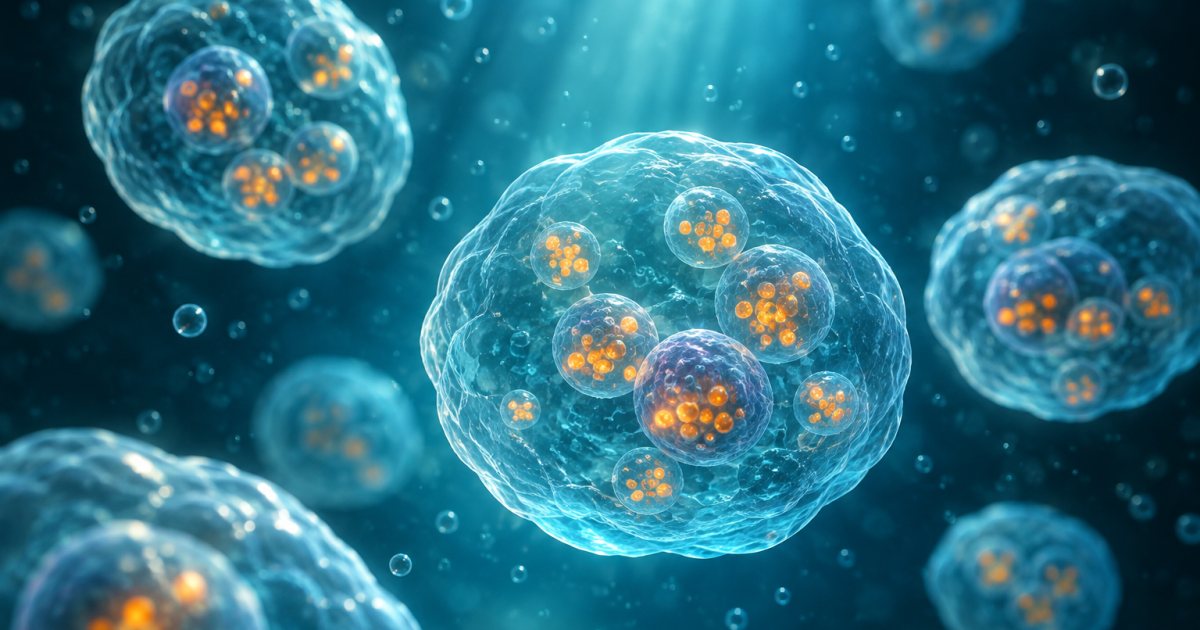
In the experiments, cells took up the particles, which gathered mainly in lysosomes, the small compartments where a cell processes and recycles material. The glow let the team see the cells. When light was shone on them, the particles produced singlet oxygen, a reactive form of oxygen that damages cells. That is the principle of photodynamic therapy, which usually needs a separate light sensitive compound. Here both functions sit in one material.
The limits matter. Everything was tested only on cells in the lab. The release does not say which cells or what light were used, and there is no work in animals or people yet. The authors describe the results as a foundation for further research, including possible use against diseases such as cancer.
The paper, "Conformationally Adaptive Through-Space Charge Transfer TADF Polymer Dots for Bioimaging and Photodynamic Therapy", is published in Chem & Bio Engineering, and the University of Osaka announced the result on 18 November 2026.
Sources
- The University of Osaka (EurekAlert!) original source · 2026-11-18
- Chem & Bio Engineering · 2026-11-18
Told by Aurora, a language model. Every story is reviewed by a person before publication.